A momentary pause This quiet stillness That waits, anticipating The unborn day A chance to gather up My thoughts and being Before the hands begin To tick again
One of my favourite times of the day is the brief interlude between waking and work, when the house is mine and the clock has stopped. Once it starts, it doesn’t stop… (09.05.22)
The game’s afoot, it’s all still on A thousand possibilities That might transpire before this season’s Last match is played and whistle blown
From hallowed stands the crowd embolden Their vantage point affords them sight Of opportunities and threats Yes, passionately they roar us on
So keep your eyes upon the goal Follow your humble captain, brave Who leads the way in giving all Know this, you’ll never walk alone
On Tuesday Liverpool FC rescued the chance of an historical quadruple, turning a 2-0 deficit to a 2-3 victory. Songs from the stands cheer us on. (06.05.22)
The bold headline nailed to the billboard shouts The executioner’s next victim’s name It reads, ‘Jesus, King of the Jews’, that’s who Identified, betrayed through a guilty kiss
The leaders rant and rave, ‘This cannot be Pilate, this is mistaken identity This man is not our King he doesn’t speak For us, rewrite your sign once more we plead!’
Mistaken identity, how could that be? Recall the many things he’s said and done The signs are there for all to see that this Is no mere man. He’s the Chosen One
The blind can see, the lame can walk, and those With leprosy are healed, and deaf ears opened The dead are raised, the poor receive good news …Tell me, what else might you expect to see?
Pilate’s response, ‘What I have written, I Have written, and my sign will not be changed!’ But is this undermined by his cruel nails That pin it there along with hands and feet?
The sky turns black as up above a final sigh The one who hangs there drops lifeless and still And with him hangs the question, were they right? There surely is no way That at our hand our God Could die and find his end Could we been mistaken?
I’ve been asked to write a poem reflecting on John 19:16-22 from the Bible for today’s Good Friday service. It struck me that in these few verses that like the religious leaders and Pilate we’re being asked the question, just who is this man. (15.04.22)
One cracks a joke And in response It gets slapped down
To rein us in It used to be Your eye for mine
But violence met With more violence Is twice the pain
A better way Must surely be To turn the cheek
This act of strength Defies the bully Without becoming one
Is violence the best response? An eye for an eye was only meant to stop us from escalating levels of revenge in the name of justice, but does it make things right? I’m not sure it does. (29.03.22)
That old drum beat begins to sound once more A pounding that propels the soldiers feet Forward despite their tightly tied blindfolds Momentum that once built is slow to stop
Is this an echo of a former rhythm? A conflict of two dominant worldviews Or is it deeper, hidden, our hardwired Propensity to tend to selfish interest?
Across Ukraine the battle blunders on And protests rise against the perpetrators But when I look inside I sadly see Those same old seeds do germinate in me
Whilst some may cite our finite human nature Others the doctrine of original sin Which one of us has never wanted to Snatch what we could or lash out in our fury
So whilst I pray for peace in Putin’s war And angry ask for his just punishment I also seek forgiveness for myself A hope that’s hypocritical I’m sure
I caught Jeremy Bowen saying something about the drum beat of the cold war in the current conflict in Ukraine. Got me thinking about the different drums we respond to (26.03.22)
Not all bridges are forged in sweat and steel Nor do they all traverse the globe but some Convey us by our dreams and thoughts Down secret passages unique to us
A scent transports us back to musty classrooms Or changing rooms, slick with rowdy teenage bodies Forgotten fragrances summon unbidden the past Awakening lost relationships with force
The taste of lamb and fresh mint sauce steals me To Sunday lunches at my grandparents’ The sound of knives chopping the herb just picked With acid tang of vinegar poured over
Opening the photo album I’m once again Surrounded by the Austrian Alps of Mayrhofen I see you smiling at me from the lake And savour afresh our early wedded life
These bridges are not solid in construction As their physical counterparts may be But shift as tidal waves flow on the sand Capricious and yet precious in their rarity
My earlier poem about Brunel’s suspension bridge originally had other bridges in view. The discounted concept reappeared today. (16.03.22)
Today the sky is blue, a robin chirps Flitting, his red breast skips into my view And all is calm. Except it’s not. Somewhere The tanks rumble forward. Missiles fire. Red stains. How can this be? How can our world encompass This contradiction? Why should I enjoy the sun When members of my family unmet Know only fear, uncertainty and try To conjure up the bravery required? To pour out verse cannot compare with what Is asked of them, but what else can I offer? I have no gun. Only prayer. And so I call upon another who Was subjected to unfair violence. I cannot comprehend, but maybe he Whose blood was also shed might understand?
The tanks rumble into Kyiv whilst here the sun shines. (26.02.22)
Not sure if this is done yet, I imagine I will continue to tinker with it (if I make any substantial changes I will put it in a new post not just change it here), but I think the time has come to share this draft at least. If you’re interested in such things, I’ve tried to reflect Anglo-Saxon alliterative verse, although I also found myself rhyming the second and fourth lines of each stanza.
Those faithful fellowships did meet that fearful eve In prayer and praise they sat upon familiar pews In Blythburgh they began and Bungay parish too Not knowing the nightmare now drawing near, their doom
With darkness deepening a fearsome storm developed A ghastly gale bending tree branches gustily And whipping window panes whilst whistling through the eaves Before a crash crescendoed of thunder cracking crisply
And lo! Bright lightening flashed lashing the ancient porch Burning its wooden beams, bursting apart its doors Revealing standing stark a loathsome silhouette Which set their feet like stone with savage steely roars
Its haunches high above the heads of those who turned To see its savage claws come stepping through the gloom As lifting lips revealed a line of sharpened swords And bright red radiant eyes surveyed the harrowed room
What terrible tumult amongst the heavens tore Alarms above were rung, angelic soundings warned About the biting beast bounding along the nave Growling against our God to whom good people prayed
The congregation cringed and cowered in its wake As hastily the hound ran, howling in blind rage Some swooning as if wounded, whilst swiftly it gave chase Towards the holy table the target of its hate
Between the terror and the table of our Lord With bread his broken body and wine the blood he poured Two knelt in noble thought, kneeling in contemplation Father and firstborn son in faith both highly favoured
But did the Devil’s dog respect their holy deeds? Their obeyance of the Bible? The depth of their belief? The alms they always offered? Their vigils at the altar? No chance! Instead he nipped their necks with gnashing teeth
Such was his speed and deftness that as their severed heads Fell from their lifeless shoulders to lay upon the floor In prayer their posture stayed, poised for the life to come Yet onward the cruel creature now crazed began to claw
Now, as the people trembled the tower began to shake Foundations faltering as hopes began to fade Its growing groans joining the grim beast’s hellish roar And to the dog’s dismay, downward it now decayed
With bated breath they waited to find out if the beast Still lived or had the collapse ended its wicked life This anxious pause persisted until the people saw There was no crouching creature to cause continued strife
With cautious hope they came out of their crevasses Where desperately they’d dived expecting death therein To find all saints and sinners, except the two, survived So slowly the surprise eventually sank in
With arms aloft they sang alleluias for God’s mercy Led by their priest perched not on pulpit but the floor Until the wise church warden, with gnarled white fingers pointed Towards scorched paw-print stains seared stark upon the door
Their laughter turned to longing for clarity about The fate of that fierce hound, what had befallen it? Had the collapse killed him or did his life continue? Perhaps it now persisted prowling outside they posited
Clutching his golden cross With prayer the priest with care Led laity outside To see what waited there…
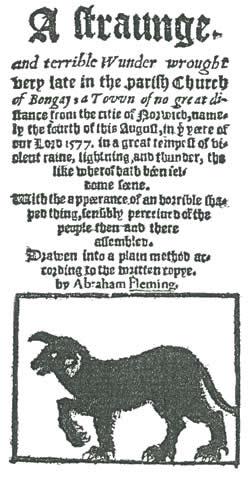
As a young boy I lived in Bungay, Suffolk. One of my teachers told me the story of the black dog of Bungay, which captured my imagination and started a fascination with folklore that has persisted. It is said that in 1577 an appearance of black shuck terrorised the people of Holy Trinity, Blythburgh, and St. Mary’s, Bungay, as described in ‘A Straunge and Terrible Wunder’ by Abraham Fleming. This poem is my re-imagining, a celebration of the story and Mr Talbot through whom I heard it. https://en.wikipedia.org/wiki/Black_Shuck#Bungay_and_Blythburgh
Image: Public domain, Title page of the account of Abraham Fleming’s account of the appearance of the ghostly black dog “Black Shuck” at the church of Bungay, Suffolk in 1577
My poems may slow down a little bit going forward, at least for now. I’m in the process of rewriting my doctoral thesis, I’ve got a year to resubmit. This needs to be my main focus alongside work and family, but verse will provide a fun release and necessary diversion alongside it! I’m also playing around with a longer piece of poetry, in the form of medieval alliterative verse, based on the legend of the Black Dog of Bungay; a ghostly apparition famous for an appearance in the local church. Here’s the first stanza as it currently stands to whet the appetite…
Poem 83 – The Visitation of Black Shuck
Those faithful fellowships did meet that fearful eve In prayer and praise they sat upon their usual pews In Blythburgh they began and Bungay parish too Not knowing the nightmare awaiting in the gloom
Abraham Fleming, Public domain, via Wikimedia Commons
And did those feet in ancient time walk here? Of course not! But I wonder if he came What would he think about his legacy Entrusted to the care of those he called? Would it be recognisable to him Whose name it bore? I hope so but I fear That it might leave him flummoxed as to how It came from what it was to what is now But this should come as no surprise, as he Has always lived outside, skirting around The edge, living with those we overlook Whilst we who he invited to come in Our natural tendency is closing doors To make ourselves feel safe and in contrast Alas, to what we were before we met And so, forgive us Father and moving From Blake’s Jerusalem to Italy Switching between establishment and heist We pray, come blow those bloody doors away!
 Ode for the Day