Poem 84 – The Visitation of Black Shuck

Not sure if this is done yet, I imagine I will continue to tinker with it (if I make any substantial changes I will put it in a new post not just change it here), but I think the time has come to share this draft at least. If you’re interested in such things, I’ve tried to reflect Anglo-Saxon alliterative verse, although I also found myself rhyming the second and fourth lines of each stanza.

Those faithful fellowships did meet that fearful eve
In prayer and praise they sat upon familiar pews
In Blythburgh they began and Bungay parish too
Not knowing the nightmare now drawing near, their doom

With darkness deepening a fearsome storm developed
A ghastly gale bending tree branches gustily
And whipping window panes whilst whistling through the eaves
Before a crash crescendoed of thunder cracking crisply

And lo! Bright lightening flashed lashing the ancient porch
Burning its wooden beams, bursting apart its doors
Revealing standing stark a loathsome silhouette
Which set their feet like stone with savage steely roars

Its haunches high above the heads of those who turned
To see its savage claws come stepping through the gloom
As lifting lips revealed a line of sharpened swords
And bright red radiant eyes surveyed the harrowed room

What terrible tumult amongst the heavens tore
Alarms above were rung, angelic soundings warned
About the biting beast bounding along the nave
Growling against our God to whom good people prayed

The congregation cringed and cowered in its wake
As hastily the hound ran, howling in blind rage
Some swooning as if wounded, whilst swiftly it gave chase
Towards the holy table the target of its hate

Between the terror and the table of our Lord
With bread his broken body and wine the blood he poured
Two knelt in noble thought, kneeling in contemplation
Father and firstborn son in faith both highly favoured

But did the Devil’s dog respect their holy deeds?
Their obeyance of the Bible? The depth of their belief?
The alms they always offered? Their vigils at the altar?
No chance! Instead he nipped their necks with gnashing teeth

Such was his speed and deftness that as their severed heads
Fell from their lifeless shoulders to lay upon the floor
In prayer their posture stayed, poised for the life to come
Yet onward the cruel creature now crazed began to claw

Now, as the people trembled the tower began to shake
Foundations faltering as hopes began to fade
Its growing groans joining the grim beast’s hellish roar
And to the dog’s dismay, downward it now decayed

With bated breath they waited to find out if the beast
Still lived or had the collapse ended its wicked life
This anxious pause persisted until the people saw
There was no crouching creature to cause continued strife

With cautious hope they came out of their crevasses
Where desperately they’d dived expecting death therein
To find all saints and sinners, except the two, survived
So slowly the surprise eventually sank in

With arms aloft they sang alleluias for God’s mercy
Led by their priest perched not on pulpit but the floor
Until the wise church warden, with gnarled white fingers pointed
Towards scorched paw-print stains seared stark upon the door

Their laughter turned to longing for clarity about
The fate of that fierce hound, what had befallen it?
Had the collapse killed him or did his life continue?
Perhaps it now persisted prowling outside they posited

Clutching his golden cross
With prayer the priest with care
Led laity outside
To see what waited there…

(07.02.22)

© Ben Quant 2022
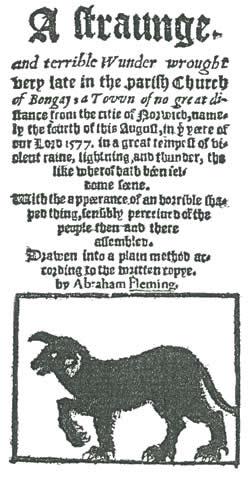
As a young boy I lived in Bungay, Suffolk. One of my teachers told me the story of the black dog of Bungay, which captured my imagination and started a fascination with folklore that has persisted. It is said that in 1577 an appearance of black shuck terrorised the people of Holy Trinity, Blythburgh, and St. Mary’s, Bungay, as described in ‘A Straunge and Terrible Wunder’ by Abraham Fleming. This poem is my re-imagining, a celebration of the story and Mr Talbot through whom I heard it.
https://en.wikipedia.org/wiki/Black_Shuck#Bungay_and_Blythburgh

Image: Public domain, Title page of the account of Abraham Fleming’s account of the appearance of the ghostly black dog “Black Shuck” at the church of Bungay, Suffolk in 1577

Poem 83 – Covid Guidelines

I’m still working on ‘The Visitation of Black Shuck’, it’s coming along nicely. In the meantime today I was challenged to rewrite the church’s Covid guidance to those hiring it for parties in verse. Over I quick cup of tea, I hastily threw this together… a bit of light relief

Our doors are open
Please come and visit
But don’t forget
We’re in a pandemic

Here are the guidelines
For us to follow
Please pop on a mask
And open a window

It’s not so wise
To gather in the middle
Don’t overcrowd
Spread out a little!

But if in the end
You’re stuck isolating
We’re more than content
To help rearranging!

(03.02.22)

© Ben Quant 2022

Coming Soon…

My poems may slow down a little bit going forward, at least for now. I’m in the process of rewriting my doctoral thesis, I’ve got a year to resubmit. This needs to be my main focus alongside work and family, but verse will provide a fun release and necessary diversion alongside it! I’m also playing around with a longer piece of poetry, in the form of medieval alliterative verse, based on the legend of the Black Dog of Bungay; a ghostly apparition famous for an appearance in the local church. Here’s the first stanza as it currently stands to whet the appetite…

Poem 83 – The Visitation of Black Shuck

Those faithful fellowships did meet that fearful eve
In prayer and praise they sat upon their usual pews
In Blythburgh they began and Bungay parish too
Not knowing the nightmare awaiting in the gloom

Abraham Fleming, Public domain, via Wikimedia Commons

Poem 82 – The Magic Word

You’re wrong to say magic does not exist
How do I know? I’ve seen it for myself
I’ve seen it in the power of verse to change
An outlook with a skillful choice of words
A clever phrase or metaphor provokes
New meaning formerly concealed, unknown
Whilst written symbols move knowledge across
Invisible mind bridges out of view
Bold stories pluck our eyes, transplanting them
Imagination thus breeds empathy
Whilst in the theatre players exercise
Surgery, switching hearts and souls
So hesitate before inscribing views
Articulate your words aloud with caution
They’re incantations not just spoken sounds
True magic not fantastic fabrication

(30.01.22)

© Ben Quant 2022

Poem 81 – The Freedom of Flatness

Some say these dark drained lands are empty, dull,
Vast, boring landscapes stripped of growth except
Unnatural poplar lines which interrupt
The fields proudly, a giant picket fence

The rest is flat, a murky flat, devoid
That stretches on for miles and miles and miles
Even its drains seem still and slowly flow
Found wanting under gravity’s strong trial

Depressing, black the peat which forms this ground
Can ground the unfamiliar down and bring them low
Our vision though is not confined like others
By contours, trees or other upward growth

Cast off the blinkers raise your eyes and see
Forget the pull of earth’s deep prejudice
Don’t be constrained to two dimensions only
Lift up your weary eyes find evidence

This land makes space for that which downwards fills
The mist which hangs in early morning dim
Fen blows that sharply tear across the flats
Unfettered sky set free to have its fun

The clouds can play and nighttime stars shine bright
And awesome Moon around the Lantern* glow
This land’s not bare but full and overflowing
This canvas primed for heavens’ masterstrokes

* The octagonal tower which rises from Ely Cathedral, which dominates the skyline of the Cambridgeshire Fens.

I grew up in the Cambridgeshire Fens, a vast stretch of drained peat devoted mainly to farming. It’s a stark landscape; absent are the usual features gloried in by lovers of the countryside. Once you learn how to see it, though, it has its own majestic beauty which lingers in the memory.
(29.01.22)

© Ben Quant 2022

Poem 80 – The Job

And did those feet in ancient time walk here?
Of course not! But I wonder if he came
What would he think about his legacy
Entrusted to the care of those he called?
Would it be recognisable to him
Whose name it bore? I hope so but I fear
That it might leave him flummoxed as to how
It came from what it was to what is now
But this should come as no surprise, as he
Has always lived outside, skirting around
The edge, living with those we overlook
Whilst we who he invited to come in
Our natural tendency is closing doors
To make ourselves feel safe and in contrast
Alas, to what we were before we met
And so, forgive us Father and moving
From Blake’s Jerusalem to Italy
Switching between establishment and heist
We pray, come blow those bloody doors away!

A counterpoint to Poem 79…

(28.01.22)

© Ben Quant 2022

Poem 79 – We, The Echo

Across the valley’s sides
The sound is mimicked as
A bird repeats its owner
Rehearsing copied phrases

These sounds, whilst not the same
As imperfections intrude
Decaying patterns fade,
Are recognisable
The second valve follows
The beating heart’s first drum

Tonight your people meet
Inspired by their God
The Father, Spirit, Son
Living in unity
Bound by their common love
That reaches outwardly

Our simple prayer remains
That as your love echoes
Across this valley’s sides
It’s found reflected here
Repurposed in our lives

Although we smudge your image
The paint is smeared as printed
We hope as we live out
Our lives amongst our neighbours
That they might recognise
The fumbled love we offer
Originally has
It’s source in you, the start
The Word in the beginning
Who set the echo off
And like an avalanche
May the cascade begin

(27.01.22)

Last night our church family gathered. We talked about who we are and the people we want to be and overnight this conversation became a prayer.
© Ben Quant 2022

Poem 78 – Close Encounter

First of all I sense it coming
Growing tension in the air
Building pressure ominous, the
Beast approaches drawing near

Then I hear a snarling note with
Pitch increasing, Doppler lift
Whining of four spinning wheels
Aggressive, through the gears it shifts

Body tensing, past experience
Muscle memory plays its part
Instinctively I know what’s coming
Snapping heels, approaching fast

Swift, it steals manoeuvre room by
Leaping, yapping, at my side
Adrenaline floods through the system
Now its time for flight or fight

Finally it cuts inside, a
Reckless swerve inches away
Pounding heart within my chest, I’m
Left exclaiming, all in vain


News of impending changes brought a cheer in our household. As a cyclist, I have experienced too many occasions where drivers have aggressively overtaken me, passing far too closely and cutting in dangerously, even turning left across my path (please note, I’m not saying all drivers are villains, or cyclists good road users).

(24.01.22)

© Ben Quant 2022

Poem 77 – WWW.

They say you can be lonely in a crowd
Feel isolated, solitary even, in
A throng of others densely gathered round
The tree, perhaps, resides in this position
Bearing so tall, so mighty and so proud
Aloof, and self-sufficient, self-assured
Possessive, owning its own patch of ground
The tree’s an isolated individual
Yes, even in a wood this seems the case
They congregate but each stands on their own
There’s no society found in this place
Where every trunk extends skyward alone
But this estrangement’s our misapprehension
Their interaction’s taking place elsewhere
As down beneath our feet there’s conversation
Within the soil a constant silent prayer
Communing in earth’s cold and damp, dark bed
Along pale fibres intercessions flow
Their whispers spread through mediating threads
Ubiquitous networks of fungal growth
No tree in isolation stands but each
By every other in the wood is cared
No one in need finds it is out of reach
As warnings, news and nutrients are shared
We celebrate the world wide web’s creation
Enabling arms to reach around its girth
But nature could have been our inspiration
Its wood wide web first stretched throughout the earth

I was first properly introduced to the concept of the wood-wide-web when reading Underworld by Robert Macfarlane (https://www.goodreads.com/book/show/40643657-underland). He writes of the infectious enthusiasm of Merlin Sheldrake (https://www.merlinsheldrake.com/), one of the leading researchers into this symbiotic relationship between trees and fungus, which allows communication across vast areas in ways which until very recently we were unaware of. Absolutely fascinating. His ‘Entangled Life’ is next on my reading list…
(21.01.22)

© Ben Quant 2022

Poem 76 – Red Lines

This morning drew a thin red line
Delineating night from day
Thus separating what has been
From what has yet to come our way
Meanwhile another thin red line
Emerged upon my plastic stick
Announcing I could play my part
In all this new day might yet bring

Another quick one today, after a full day of work and college. Brain full of toddlers, practical theology and commuter trains for anything more imaginative or deep!
(19.01.22)

© Ben Quant 2022