We sit outside, enjoying Spring’s fresh sun, sharing a cup of tea and conversation. The heavens’ freshness is invigorating, shining light into wearied Winter limbs.
We aren’t the only ones awakened by the afternoon’s blue opportunity; the sky swells with ranks of choristers, alert, their chests puffed out with jubilant song.
Performing bass, the racket of the rooks erupts, joining the tree-born tenor pigeons’ coos. Insistent great tits drill their alto beats, as greenfinch glissandos trill in soprano splendour.
At the finale’s final flourish we file out of the garden, aware that we’ve been treated by a most marvellous rendition of this anarchic avian anthem. We applaud.
Yesterday afternoon, I sat outside with my parents, ensuring the weather and the glorious birdsong. (25.03.25)
The black crows wheeled about and dived, Three harbingers of doom descending In perfect harmony, upon the man.
I knew not why they chose this wanderer, Just what his crime or cause of grief, But froze in horror as they harangued him.
Their cawing clawed along my back, Paralleling their piercing talons, Which, rampant, ripped his suit to shreds.
Brandishing his umbrella like a bayonet, He thrust it furiously at the fiends, But repelling them not retreated.
Around the corner he ran in terror, Before, when out of sight, he screamed A sound like shrieking foxes wailing.
At last I roused myself and ran To offer help in fending off These beasts, but found them gone, a feather
Left lying on the floor, the only Evidence of their existence. And of the man? No sign remained…
I never found the missing man, Nor saw the hellish crows once more, Except asleep in anxious dreams,
But even now I shrink in fear, Upon the sight of silent birds Aloft on wing or lonely trees.
Walking to church today I saw the crows sweeping in a curve, one before the other, in a downward dive. Starting to write about the sight, this is what came out. I didn’t intend to write gothic or alliterative verse, but that’s where it took me. (18.02.25)
‘The Norman horde must be holding us up ahead,’ I laughed out loud, as we languished in the lane. And so imagine my surprise when, making it around the roundabout, we ran into a fearsome figure fighting on a horse! Before him fought on foot a Saxon armed with axe and anger, armour dulled by blows so skillfully cut by William’s swiping sword. Thus trapped, the tortured troops of Harold stand, eternally caught in conflict with the Conqueror.
Driving to a conference today, we were held up in the Sussex town of Battle… (11.02.25)
I have been made complete, moulded by my maker. I am an image bearer, bearing his image in my body. With care my character will carry his within it; reflecting the family face in my visage, his will and wants within my walk. But man is not the mirrored, only the mirror; I must not imagine I am him, for in imagining this I become an idol. For I am not complete unless I live in him for only in his affection can I finally find my home.
As local ministers we meet once a month to reflect together on a book. We’ve started with ‘The Unhurried Pastor’ by Brian Croft and Ronnie Martin, and our conversation today about being limited beings, who find completion in him and his provision, led to this alliterative verse. (03.02.25)
In wonder, we walk these woodland worlds, That groan beneath green garlands of moss. This verdant dressing, vivid and vibrant, Drapes the boughs and cloaks their branches. Tacking across our track, a trickling Stream carves stripes into our path, Whilst, circling up above, black corvids Caw at red kites above the castle. Is this a place where faeries frolic, Fearless in their velvet kingdom?
Today we walked the third chain of the Hertfordshire Chain Walk (we’re going back to do the second another day). At times the landscape was quite magical. (01.02.25)
Thrashing its shiny tail from side to side in raging rancour the rising dragon roared; a cry that caused the cavern walls’ collapse and, harrowed, our heroes’ hearts to pause.
With a weighty stamp the beast made wave the floor most furiously, causing them to fall, but rallying they raised their righteous spirits; emboldened by belief in their beautiful call.
The pious paladin picked his spot with prayer, and grasping his glaive he struck a grevious blow; but such its size, the serpent barely felt, the piercéd pupil pricked from down below.
With furious vapours it fought to seize control, enfolding its foe in flames from gaping doors formed by its mighty jaws made red and wide, that reached from rising roof to hardened floor.
Aiming at the arrogance he’d heard may leave a learing lizard lying prone, a doughty sea-dog sought to deal him doubt and at his hardened heart his words did home.
And did the dreadful dragon hesitate, distracted or entranced by tricky terms? It must be so because, somehow, the flame-licked fighter fought despite the burns.
These alliterative verses emerged from the tremendous evening’s party that formed the first half of the finale to a highly enjoyable role-playing game campaign. More may follow… (23.01.25)
Leon, like, I literally love, But loopy Linda what a laugh!
Lisa left her liturgy, whilst Shameful Charlotte shifts her tongue.
Manipulating Minah makes her move But fearful Freddie finds the answer.
Francesca chooses to chew things over But artfully, Alex avoids attention.
As Alexander articulates Leanne angrily argues back.
Jubilantly Jake announces, ‘I knew it!’ but Anna never knows it’s coming…
Will feuding faithfuls find the faithless or treacherous traitors survive in triumph?
The opening admiration of Leon was uttered by one of the contestants on The Traitors last night (15.01.25). It’s alliteration immediately caught my attention, I knew it had to become a poem… (16.01.25)
The ghost of Gerrit grumbles through our garden, its urgent whispers whipping leaves away in merry dances, diving down amongst the branches before rebounding skywards. Above, the languid light retreats, leaving our cloud shrouded landscape down below; its inhabitants hiding behind curtain covered windows, seeking warmth from winter’s cold.
A piece of alliterative verse inspired by a gloomy day between Christmas and New Year, with the weather still affected by the tail end of Storm Gerrit. (30.12.23)
Not sure if this is done yet, I imagine I will continue to tinker with it (if I make any substantial changes I will put it in a new post not just change it here), but I think the time has come to share this draft at least. If you’re interested in such things, I’ve tried to reflect Anglo-Saxon alliterative verse, although I also found myself rhyming the second and fourth lines of each stanza.
Those faithful fellowships did meet that fearful eve In prayer and praise they sat upon familiar pews In Blythburgh they began and Bungay parish too Not knowing the nightmare now drawing near, their doom
With darkness deepening a fearsome storm developed A ghastly gale bending tree branches gustily And whipping window panes whilst whistling through the eaves Before a crash crescendoed of thunder cracking crisply
And lo! Bright lightening flashed lashing the ancient porch Burning its wooden beams, bursting apart its doors Revealing standing stark a loathsome silhouette Which set their feet like stone with savage steely roars
Its haunches high above the heads of those who turned To see its savage claws come stepping through the gloom As lifting lips revealed a line of sharpened swords And bright red radiant eyes surveyed the harrowed room
What terrible tumult amongst the heavens tore Alarms above were rung, angelic soundings warned About the biting beast bounding along the nave Growling against our God to whom good people prayed
The congregation cringed and cowered in its wake As hastily the hound ran, howling in blind rage Some swooning as if wounded, whilst swiftly it gave chase Towards the holy table the target of its hate
Between the terror and the table of our Lord With bread his broken body and wine the blood he poured Two knelt in noble thought, kneeling in contemplation Father and firstborn son in faith both highly favoured
But did the Devil’s dog respect their holy deeds? Their obeyance of the Bible? The depth of their belief? The alms they always offered? Their vigils at the altar? No chance! Instead he nipped their necks with gnashing teeth
Such was his speed and deftness that as their severed heads Fell from their lifeless shoulders to lay upon the floor In prayer their posture stayed, poised for the life to come Yet onward the cruel creature now crazed began to claw
Now, as the people trembled the tower began to shake Foundations faltering as hopes began to fade Its growing groans joining the grim beast’s hellish roar And to the dog’s dismay, downward it now decayed
With bated breath they waited to find out if the beast Still lived or had the collapse ended its wicked life This anxious pause persisted until the people saw There was no crouching creature to cause continued strife
With cautious hope they came out of their crevasses Where desperately they’d dived expecting death therein To find all saints and sinners, except the two, survived So slowly the surprise eventually sank in
With arms aloft they sang alleluias for God’s mercy Led by their priest perched not on pulpit but the floor Until the wise church warden, with gnarled white fingers pointed Towards scorched paw-print stains seared stark upon the door
Their laughter turned to longing for clarity about The fate of that fierce hound, what had befallen it? Had the collapse killed him or did his life continue? Perhaps it now persisted prowling outside they posited
Clutching his golden cross With prayer the priest with care Led laity outside To see what waited there…
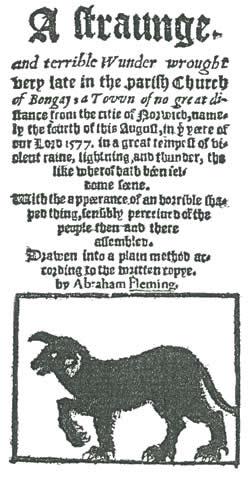
As a young boy I lived in Bungay, Suffolk. One of my teachers told me the story of the black dog of Bungay, which captured my imagination and started a fascination with folklore that has persisted. It is said that in 1577 an appearance of black shuck terrorised the people of Holy Trinity, Blythburgh, and St. Mary’s, Bungay, as described in ‘A Straunge and Terrible Wunder’ by Abraham Fleming. This poem is my re-imagining, a celebration of the story and Mr Talbot through whom I heard it. https://en.wikipedia.org/wiki/Black_Shuck#Bungay_and_Blythburgh
Image: Public domain, Title page of the account of Abraham Fleming’s account of the appearance of the ghostly black dog “Black Shuck” at the church of Bungay, Suffolk in 1577
 Ode for the Day
